Recruitment

Every candidate at their stage, every position under control.

Describe the client's position, publish job posts in the candidates' languages, collect applications from your own job board and take people through the stages to the hire.

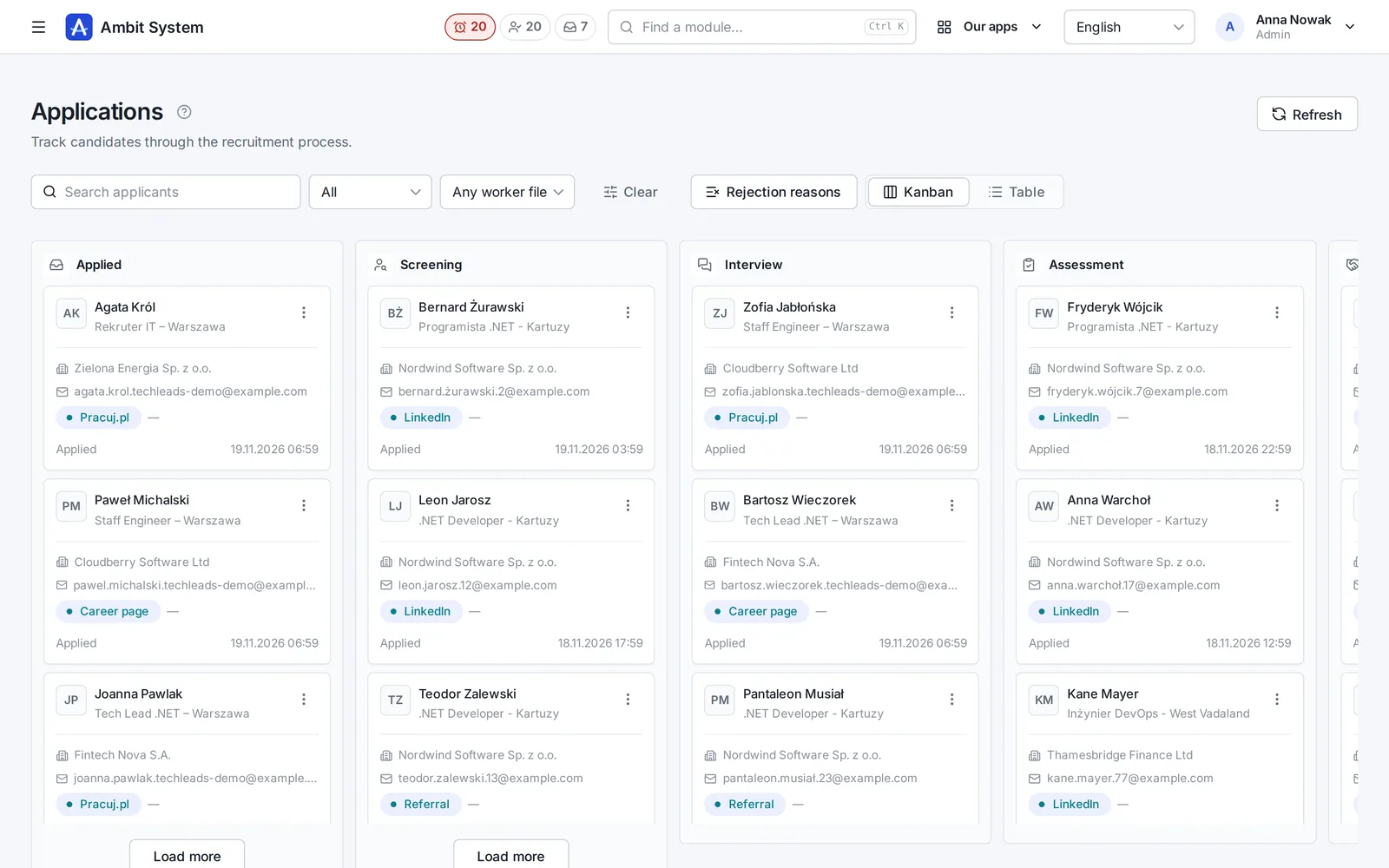
The applications board: candidates in columns of stages from applied to offer, each with the position, the client and the source.
Screens of the real system on made-up data.

How it goes today

Recruitment in an inbox, a spreadsheet and on job portals

  • CVs arrive by e-mail, from portals and from friends - each somewhere else.
  • Nobody knows which stage a candidate is at, or who last talked to them.
  • The same position described three times, in three languages, in three files.
  • Nobody watches what a candidate agreed to and how long their data may be kept.

Recruitment in Ambit System takes every candidate along one path - from the client's position to the hire - with the history and the consents in one place.

How it works

From the position to the hire

The stages exactly as the system has them. The steps a person takes are marked.

Position

One position at a client is one job description; it can have many job posts.

  1. Job descriptiondraft → open → on hold → closed
  2. Job postsone per language, written for the candidate
  3. Publicationthe agency's job board and an XML/JSON feed
  4. Job portalsby handa record of where the post went

Pracuj.pl, OLX, Praca.pl, RocketJobs, JustJoinIt, NoFluffJobs, LinkedIn, Indeed
Candidate

One application per candidate and position; applying again lands in the same one.

  1. Appliedfrom the job board, or added by a recruiter
  2. Screening
  3. InterviewHR, technical, with the client, final
  4. Assessment
  5. Offer
  6. Hired

rejected or withdrawn - at any stage

The position

One job description per client order

The internal description: for whom, where, for how much and what we require - with the history of its status.

  • Client, location, employment type and work mode
  • The salary range in the position's currency
  • Responsibilities, requirements and skills
  • Status: draft, open, on hold, closed, cancelled
  • A job post made from it in one click
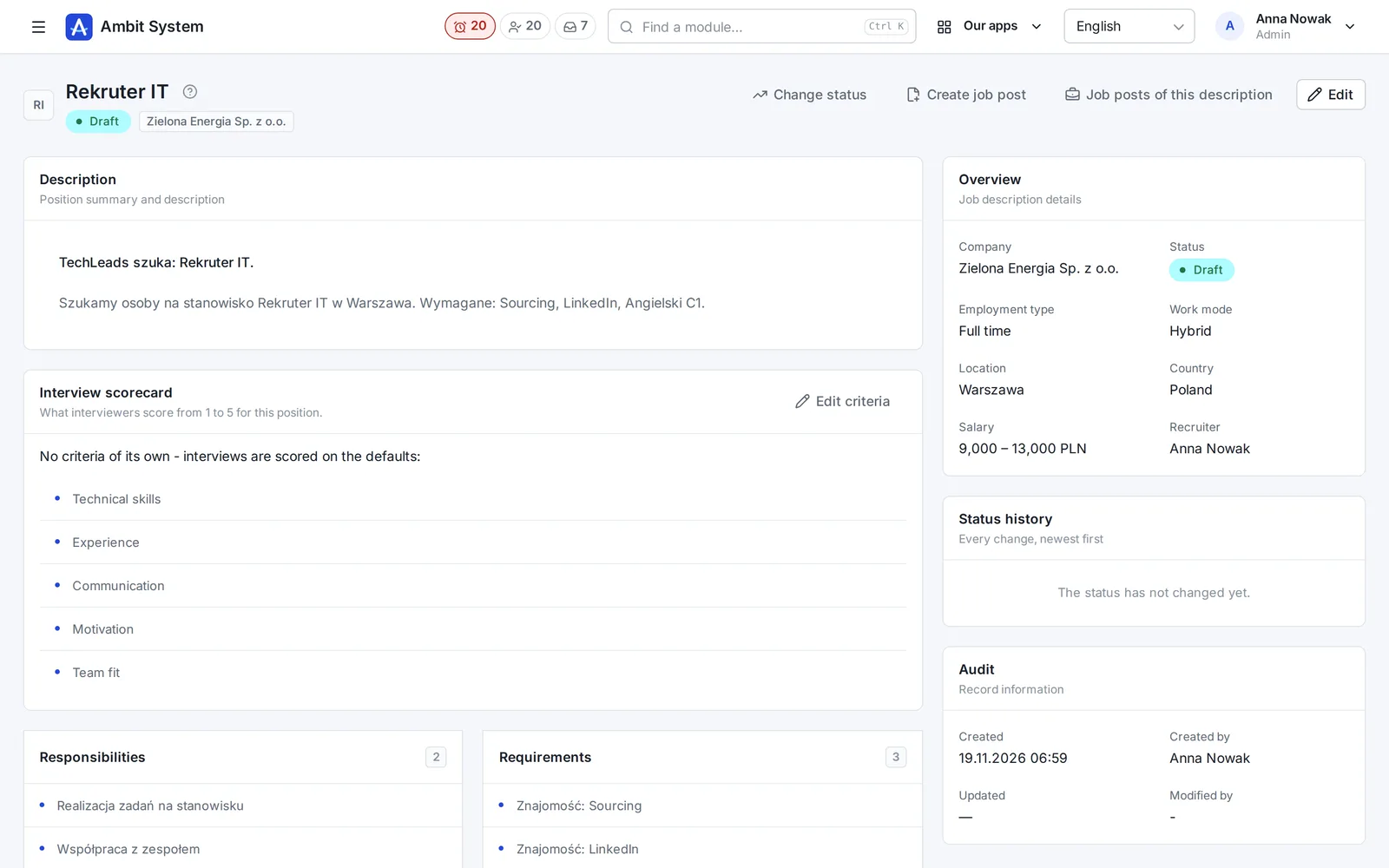
A job description: description, responsibilities, requirements, skills, and beside them the client, employment type, location and salary range.
A job description with its requirements and terms.

Job posts

A post in the candidate's language, not a copy of the description

A job post is the candidate-facing version - it may read differently from the internal description, and a position has as many as it has languages.

  • A copy into a new language in one click
  • Status: draft, published, closed, archived
  • A record of the channels the post went to
  • An application added by a recruiter when the candidate came another way
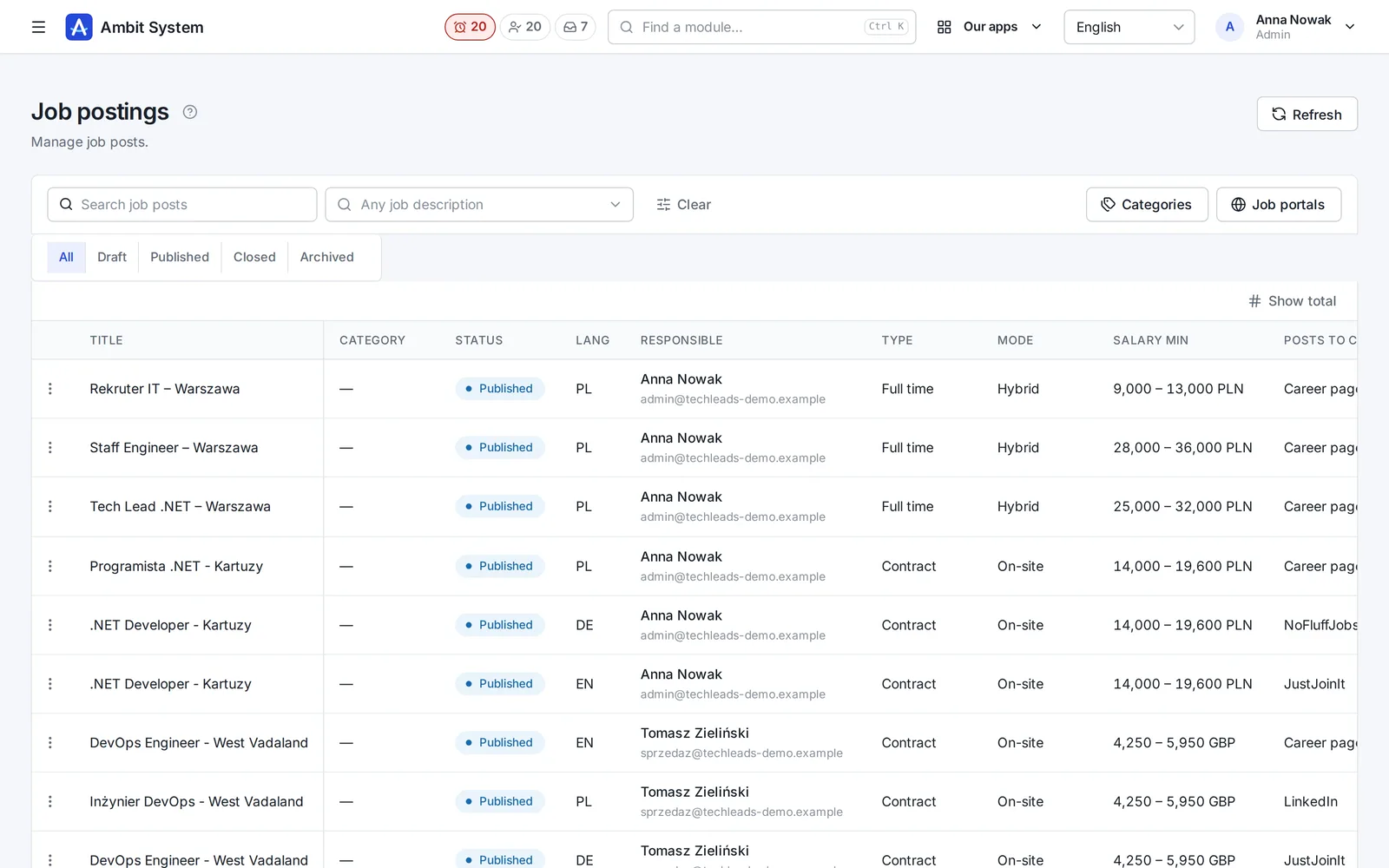
The list of job posts: title, status, language, recruiter, employment type, salary range, number of channels and client.
Job posts in several languages for the same positions.

The application

Everything about a candidate for this position

The details, source, CV, notes, messages and history - on one application page.

  • Source: the job board, Pracuj.pl, LinkedIn, a referral and more
  • A CV as PDF - one per application, checked by an antivirus before it is stored
  • Recruiters' notes and a timeline of every change
  • Messages to the candidate from templates, also on a change of stage (when you turn it on)
  • Consents and personal data in one box
  • A 1-20 rating of each application and the recruiter desk: the newest posts beside their candidates, stage by stage
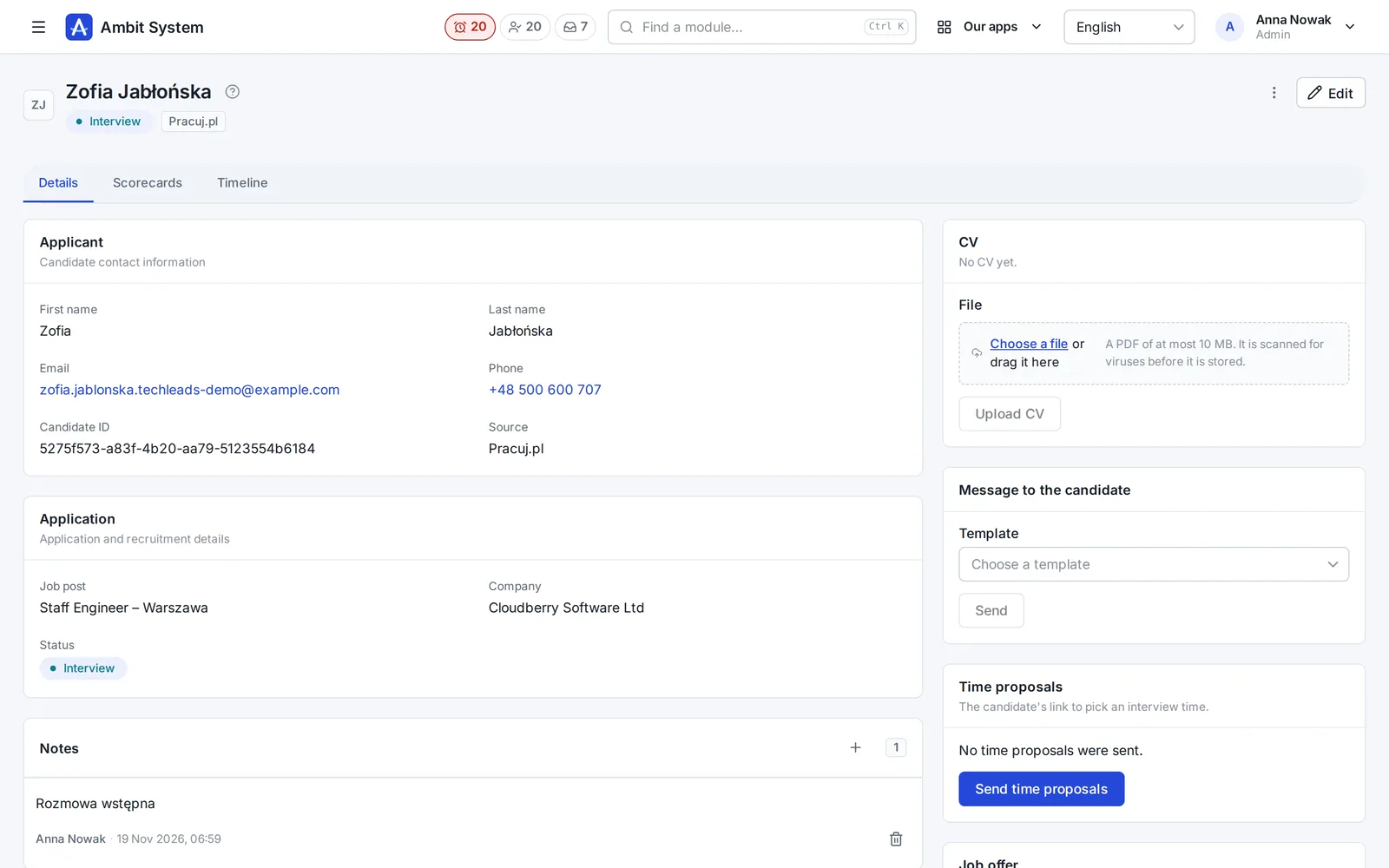
A candidate's application: contact details, position and client, status, notes, CV, a message to the candidate and consents.
An application with its details, notes, CV and consents.

Candidate and interviews

The candidate stays in your database, the interviews in the calendar

A candidate is a person in the agency's database - with many applications to different positions. Interviews have a type, a status and an interviewer.

  • The candidate's profile with the latest CV, tags and history
  • Interviews: HR, technical, with the client and final - online or on site
  • Interview status: planned, confirmed, done, cancelled, no show
  • A voice call with the candidate in the browser, booked with a link
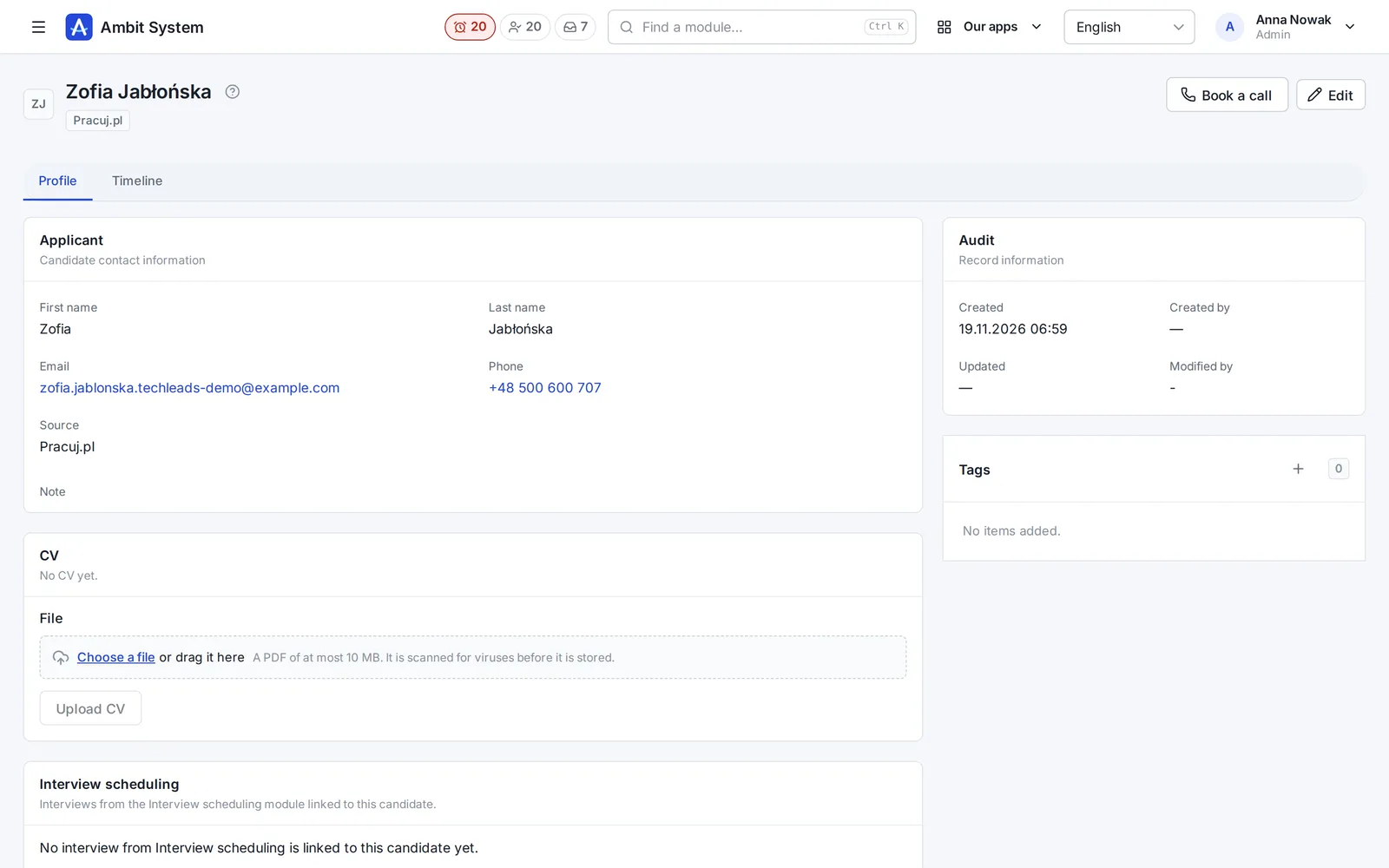
A candidate's profile: contact details, source, CV, consents, tags and record information.
The candidate's profile.
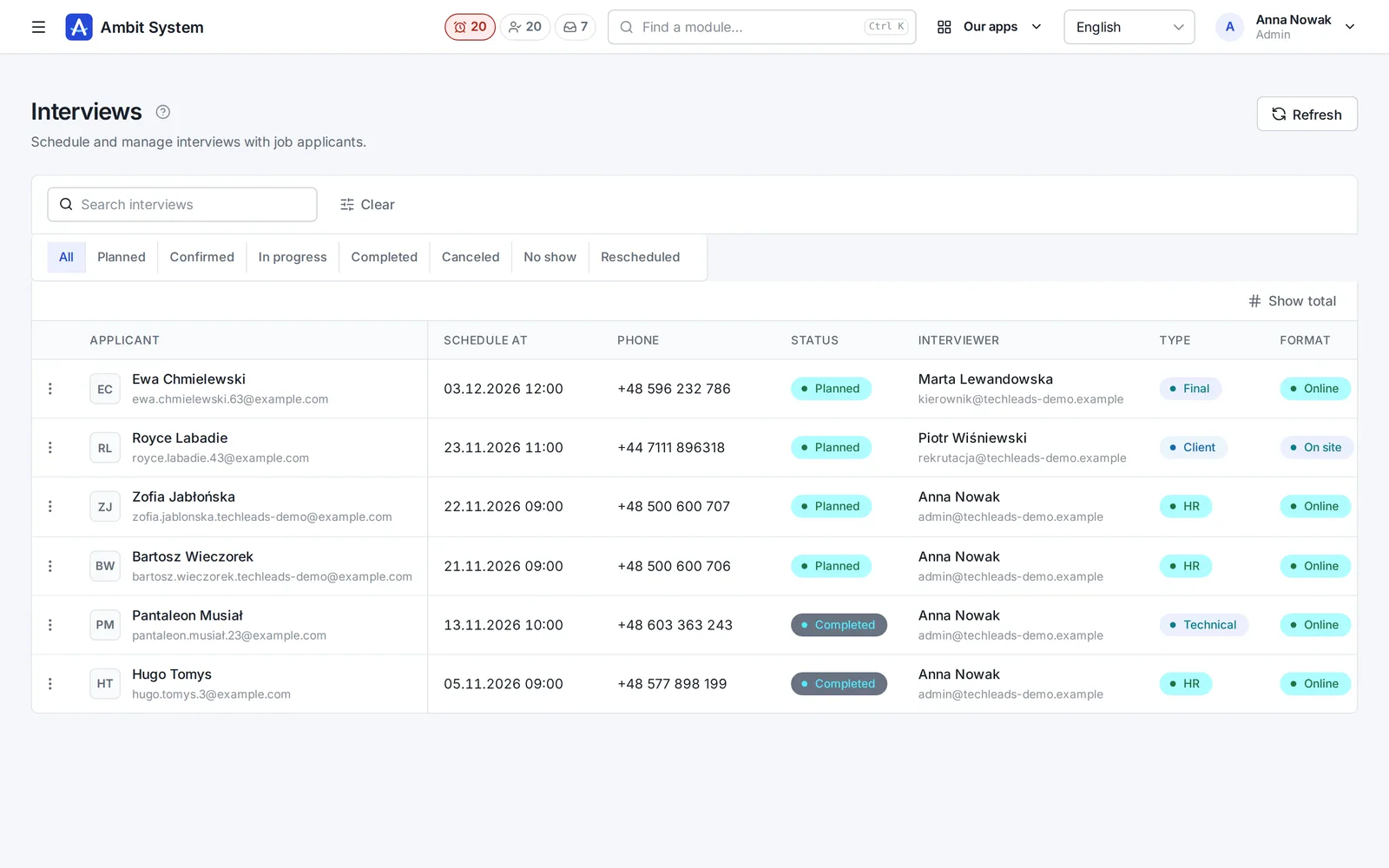
The list of interviews: candidate, time, phone, status, interviewer, type of interview and format - online or on site.
Interviews with their type, status and interviewer.

Job board and GDPR

Your own job board, and candidates' data under control

Your own job board

The agency's published job posts at its address, in its look, with an application form and a PDF CV upload.

A job feed

The published posts also as an XML and a JSON file - for sites and services that read one.

Consents

The board takes no application without consent; consents are recorded facts with the version of their wording, and a missing one shows.

Retention and erasure

Your own retention periods, a person's data extract and erasure of their data from every place - with a record that it was done.

Said plainly

What it does not do yet

We would rather you knew before the demo than after it.

  • No automatic posting to job portals: the system records where a post went; you publish it on the portal yourself.
  • No CV parsing: the PDF is kept with the candidate, but its content does not fill the fields by itself.
  • Messages to candidates by e-mail only - no SMS.
  • No tests or tasks for candidates in the system: the assessment stage records the result, it does not run the test.

Questions

Before you ask

Can a candidate apply twice for the same position?

A position has one application per candidate: applying again lands in the first one, and a new CV replaces the earlier. Another position is a separate application.

Where do candidates come from?

From the form on your job board, or a recruiter adds them - with the source, such as Pracuj.pl, LinkedIn or a referral.

Do you message candidates on your own?

Only when you turn on a rule for a stage, or a recruiter sends a message by hand, with a preview. A consent to this recruitment withdrawn stops both.

Where is the candidates' data?

In your organization in Ambit System, in the European Union. CVs are kept in a private file store, reachable only through the system.

See it working on real screens

The demo has an agency with open positions, job posts and candidates at every stage.