KSeF and settlement documents

Purchase invoices arrive on their own. Nothing else gets lost either.

Connect your companies to KSeF once and their purchase invoices land in the system with the original XML and a PDF. Every cost that never passes through KSeF goes next to them - with its file, due date and a reminder before payment.
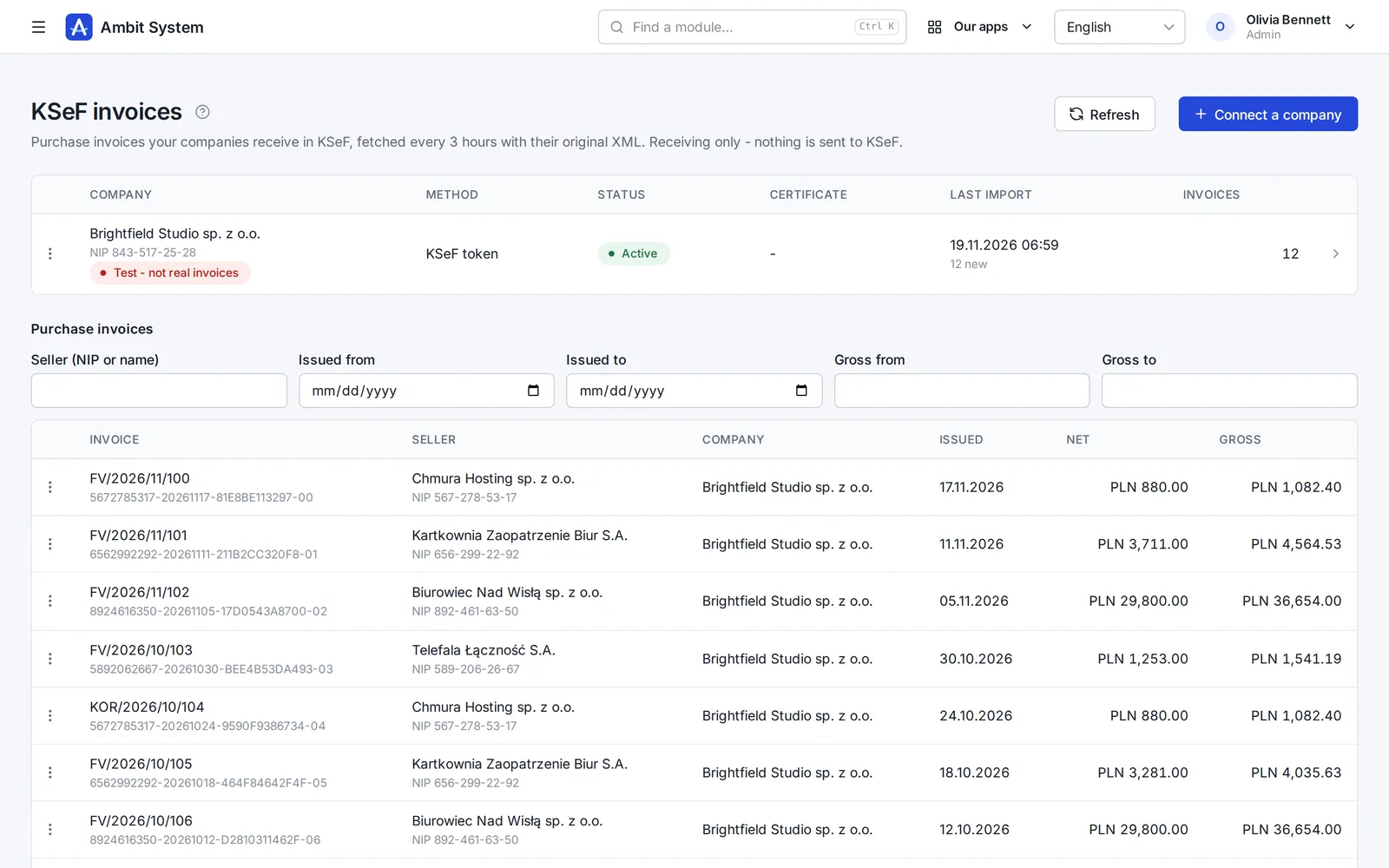
KSeF invoices: the connected company with its last import, and the list of purchase invoices with seller, issue date, net and gross.
Screens of the real system on made-up data.

How it goes today

Invoices in KSeF, the rest in an inbox and a drawer

  • Somebody signs in to KSeF by hand to see what came in this week.
  • A foreign invoice, a policy or a fine lives in someone's inbox.
  • A payment is late because nobody remembered the due date.
  • Two people pay the same bill - or nobody does.

KSeF and settlement documents keep every cost in one register: KSeF invoices fetched on their own, the rest added with its file - and a reminder before each payment.

From KSeF to paid

One path for every cost

The same register for an invoice from KSeF and a bill on paper.

  1. Connect

    Connect each of your companies to KSeF with a token or a certificate - saved only after KSeF accepts it.

  2. Import

    The first import on request, then every 3 hours; each invoice with its original XML.

  3. Add the rest

    Foreign invoices, policies, fines, notes and bills as settlement documents, with their files.

  4. Pay

    A reminder the day before the due date; marked paid with the date and who paid.

KSeF connection

Each company connected once - and imported on its own

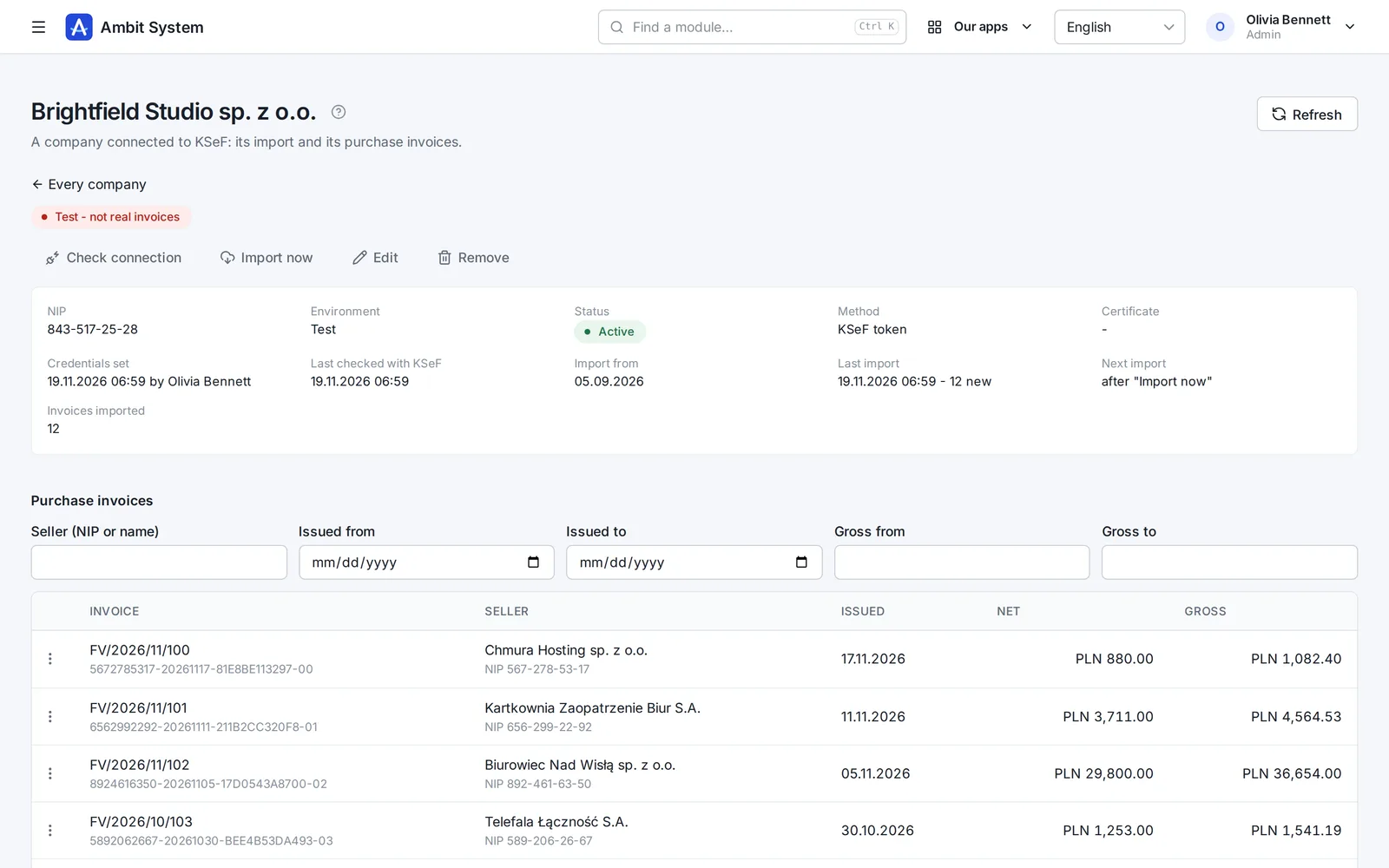
A connection per company: its method, status, last import and the next one.
  • KSeF token or certificate, stored encrypted and only after KSeF accepts it
  • "Check connection" and "Import now" when you need them
  • Up to 30 companies per organization
  • If an import fails, the administrator and finance get an e-mail
A company connected to KSeF: its tax ID, environment, status, method, last and next import, and its purchase invoices.
A connected company with its imports.

The invoice

The XML is the invoice - the PDF is drawn from it

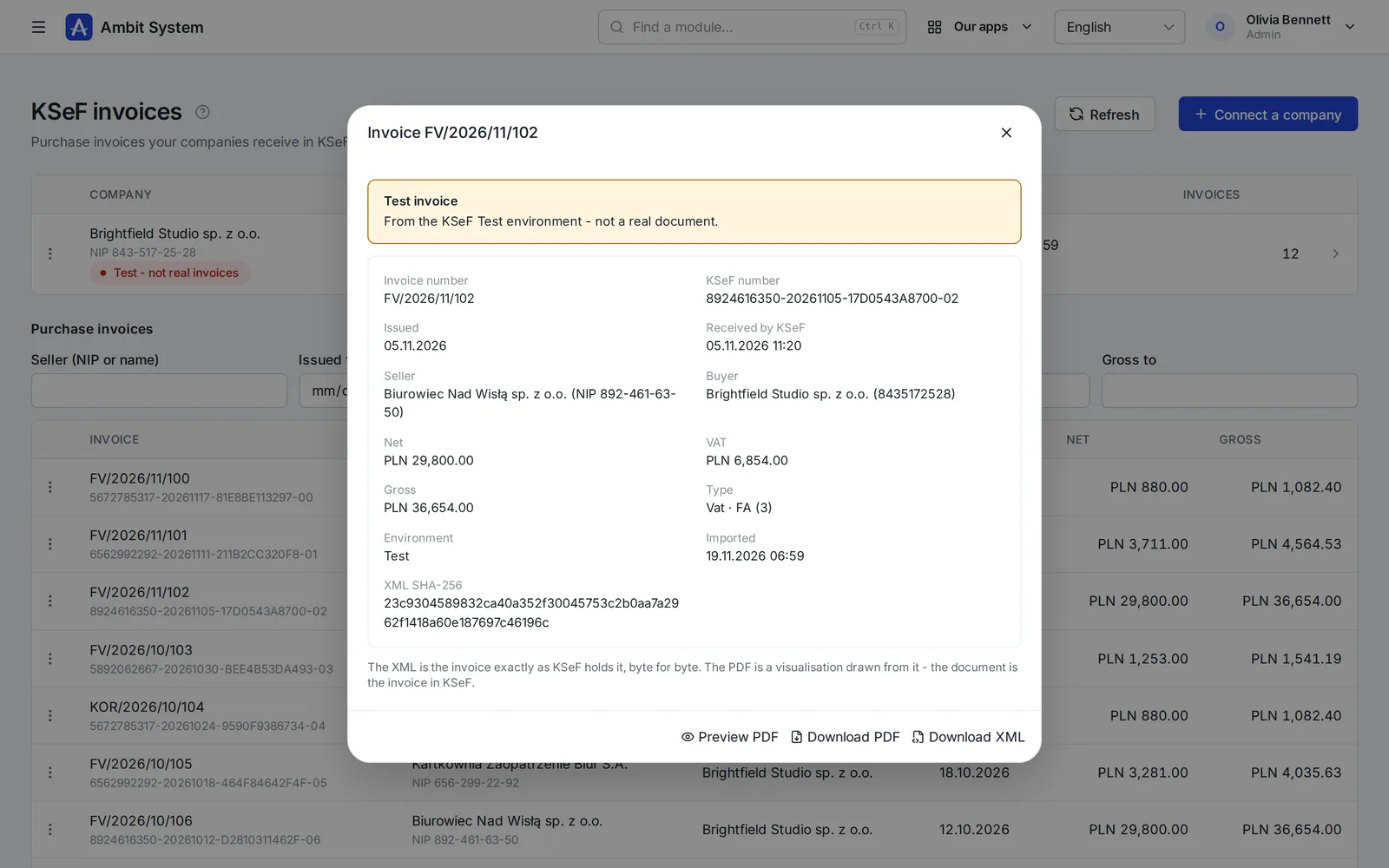
Every invoice is kept exactly as KSeF holds it, byte for byte, with its checksum.
  • Seller, buyer, net, VAT and gross from the invoice itself
  • The KSeF number and the date KSeF received it
  • A PDF drawn on request from FA(3) and FA(2) invoices
  • The original XML to download at any time
An invoice from KSeF: number, KSeF number, seller, buyer, net, VAT, gross, type and the XML checksum, with buttons for the PDF and the XML.
An invoice with its data, PDF and original XML.

Settlement documents

Every cost KSeF never sees

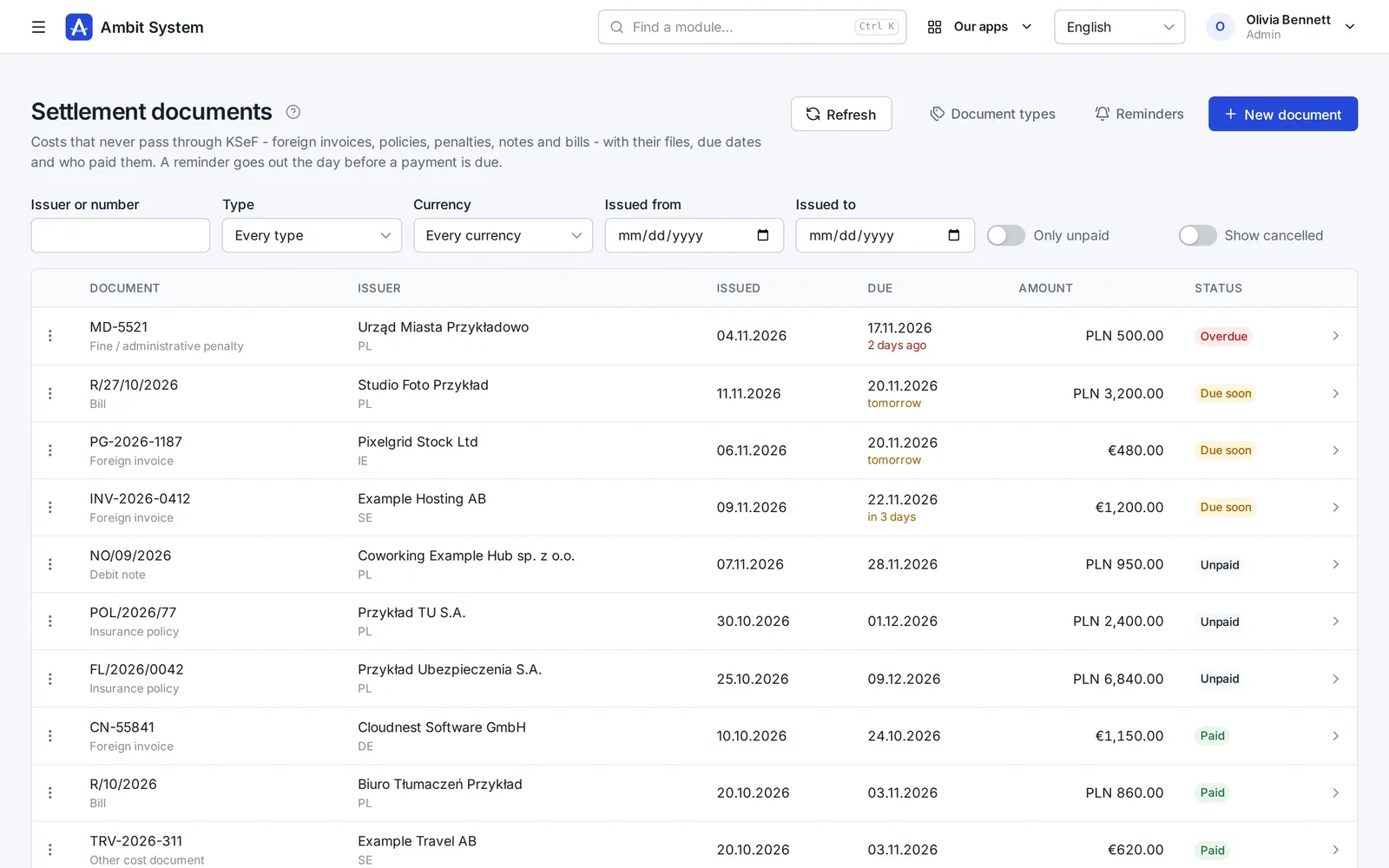
Foreign invoices, insurance policies, fines, debit notes and bills - in one register with their due dates.
  • Nine default types and your own
  • Overdue, due soon, unpaid and paid - computed for today
  • Amounts in the document's currency, never converted
  • A warning when the same document seems to be added twice
  • Filters for issuer, type, currency, dates and unpaid only
The register of settlement documents: number, type, issuer, issue and due dates, amount and status - overdue, due soon, unpaid, paid.
The register with what is overdue, due soon and paid.

The document

Who paid, when - and the file next to it

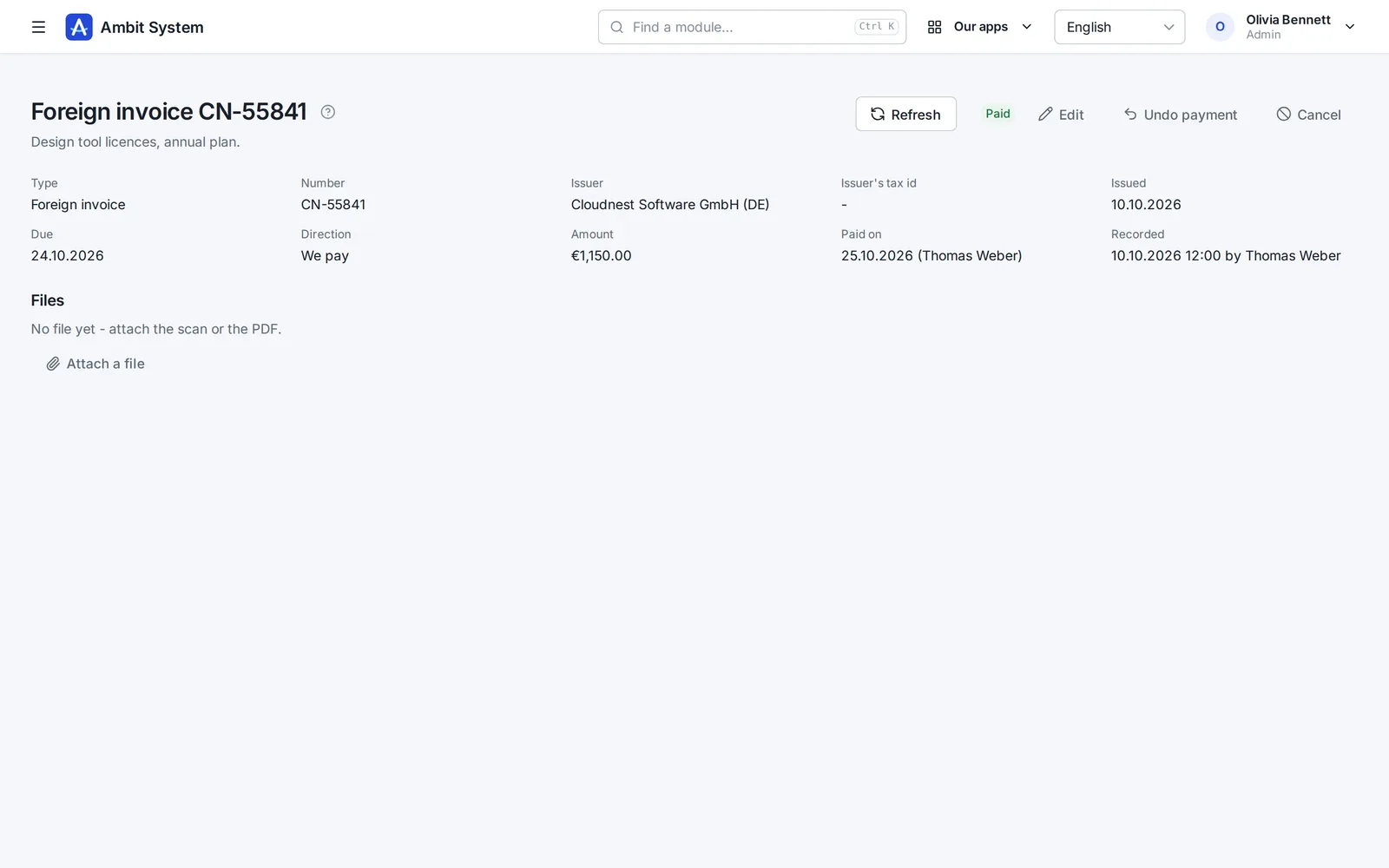
Each document with its type, direction, amount, due date, payment and files.
  • We pay or we receive - set by the type
  • Paid on a date, by a person - and undone if it was a mistake
  • Scans and PDFs attached to the document
  • A correction carries a negative amount
A paid foreign invoice: type, number, issuer, issue and due dates, direction, amount, when and by whom it was paid, and its files.
A paid foreign invoice with its payment.

Two modules

Take one, or both

KSeF and settlement documents are separate modules - each works on its own.

KSeF invoices

Purchase invoices from KSeF with their XML and PDF. For companies in Poland.

Settlement documents

Every cost outside KSeF with its files, due date, payment and reminder.

Said plainly

What it does not do yet

We would rather you knew before the demo than after it.

  • KSeF is receiving only: your sales invoices are not issued or sent to KSeF from here.
  • No bookkeeping: nothing is posted to a ledger or a VAT register.
  • No bank connection: a payment is marked by a person, not matched from a statement.
  • No approval of purchase invoices: there is no accept / reject step.
  • Amounts are never converted between currencies.

Questions

Before you ask

Who sees the KSeF invoices?

The administrator and finance. Settlement documents are open to every member of the organization.

How is our KSeF token kept?

Encrypted, and saved only after KSeF has accepted it. It never appears in a response, an event or a log.

Who gets the payment reminder?

The people you choose; nobody chosen means every administrator. It lists the unpaid documents due the next day.

Our company is not in Poland - does it work?

Settlement documents work anywhere. KSeF is the Polish national e-invoice system, so that module is for companies in Poland.

See it working on real screens

The demo has a company with its KSeF invoices and settlement documents - due, overdue and paid.